What happens when a large, multi-feature crypto platform promises the convenience of a unified Web3 gateway and the muscle of derivatives trading? That tension — between convenience and risk — is the clearest lens through which to examine OKX for U.S.-based traders. This piece walks a concrete user case: an active U.S. trader who wants to log in, move capital between spot, staking, and futures, and keep custody risk and platform frictions low. The goal is not to sell OKX, but to give traders a sharper mental model for how the product works, where its strengths lie, and where simple habits matter most.
I’ll use that case to surface one useful correction: convenience doesn’t eliminate structural risk. OKX stitches together a CEX, a non-custodial wallet, a DEX aggregator, staking services, an NFT marketplace, and full derivatives — and that combination multiplies both options and decision points. Seeing how those pieces interact clarifies the trade-offs that matter to any trader deciding whether to log in and deploy capital today.
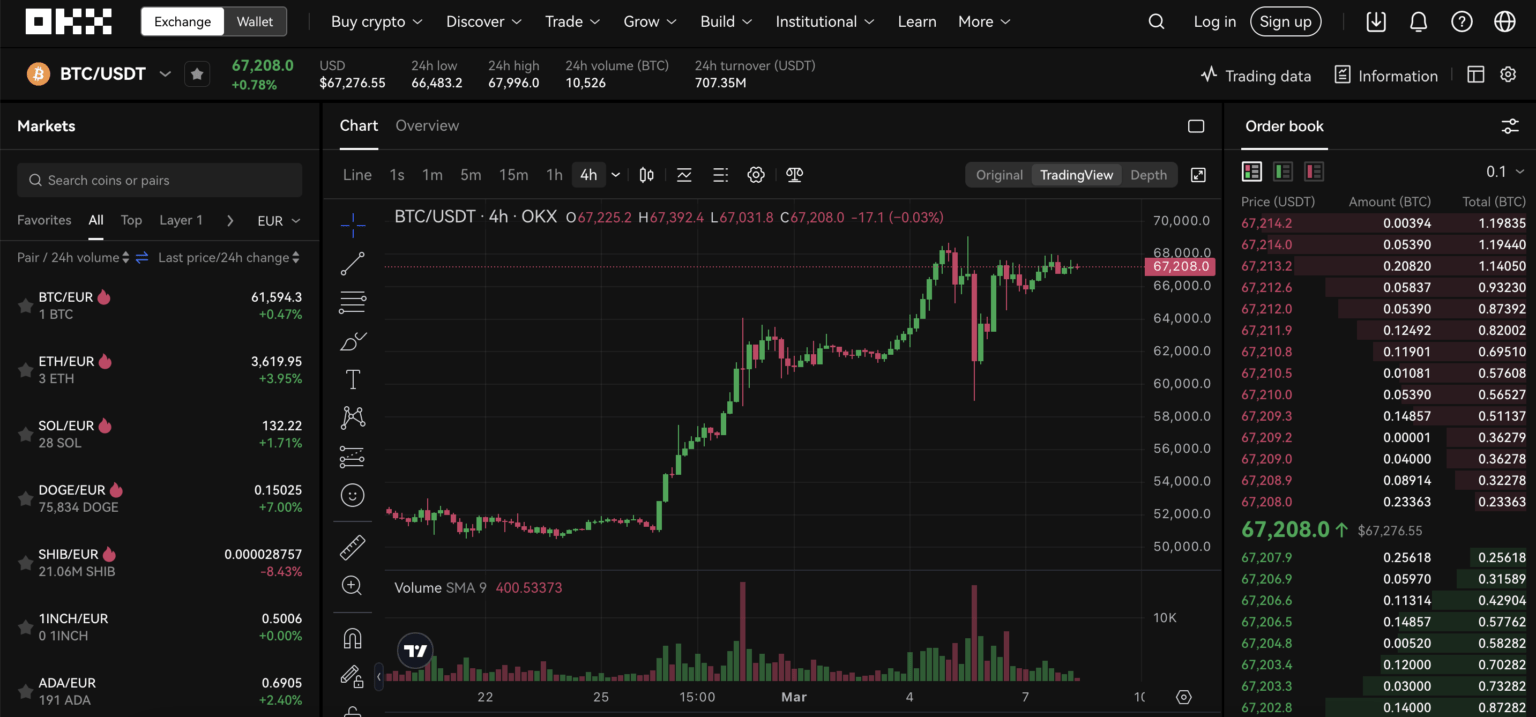
Case: Alice, a U.S. active trader who wants one interface
Alice is based in the U.S., trades BTC and ETH spot and occasionally opens short-term futures positions around news events. She wants: fast login, cross-asset transfers, occasional staking of idle stablecoins, and access to perpetuals up to high leverage if needed. Her priorities are security, regulatory compliance, low execution slippage, and predictable liquidity when she needs to exit. This concrete case highlights practical demands that an exchange must meet simultaneously: custody safety, KYC compliance, platform latency, order routing, and feature clarity.
Practically speaking, Alice’s first task is to create and secure her account. OKX requires KYC (government ID and facial liveness) and enforces 2FA (SMS, Google Authenticator, or biometrics). That matters in the U.S. because KYC is non-negotiable for withdrawals over regulatory thresholds; it also means higher operational friction on boarding but clearer legal protection for the platform and users. For immediate access, she will use the web platform or mobile app; both provide biometric logins and AI-driven real-time threat detection that improves the safety of frequent logins.
How OKX stitches custody, staking, and margin together — mechanism first
Mechanically, OKX operates two custody regimes in one product: a centralized exchange custody model for deposits and trading, and a non-custodial Web3 wallet where users control private keys and can connect to DApps. More than 95% of centralized user assets are held in cold, air-gapped multi-signature wallets — a structural defense against platform-wide hacks. Separately, the Web3 wallet leaves custody with the user, which supports hardware wallets like Ledger and Trezor. The difference matters: centralized custody simplifies trading and withdrawal flows; non-custodial wallets reduce counterparty risk but place responsibility for seed phrases squarely on the user.
For yield, OKX offers flexible and locked staking, auto-compounding, and DeFi farming options. Those features let Alice earn passive income on idle balances, but they introduce trade-offs: fixed-term staking reduces liquidity (you cannot instantly redeploy the staked amount), while auto-compounding can mask fee drag or impermanent loss when routed through certain DeFi strategies. In short, yield features increase capital efficiency but also widen the set of failure modes — from smart-contract exploits to reduced flexibility during market stress.
Futures and margin: power with constraints
OKX provides a full derivatives suite: quarterly futures, perpetual swaps, and options, with leverage up to 125x on select products and margin up to 10x on spot positions. For Alice, leverage is attractive because it amplifies returns; but mechanism-level risks are severe. High leverage makes liquidations more likely during volatility, and slippage widens in low-liquidity moments. Perpetual funding rates, maintenance margins, and cross vs. isolated margin choices materially change how a position behaves under stress. Traders often underestimate how quickly a cross-margin pool can erode if multiple correlated positions move against them.
There is a common misconception that an exchange’s Proof of Reserves (PoR) eliminates counterparty risk. OKX publishes PoR, which helps verify that on-chain reserves match user deposits — a meaningful transparency signal. But PoR does not replace operational risk controls, nor does it prevent losses from user-level mistakes (phishing, lost seed phrases) or platform-level insolvency triggered by derivatives blowups. In other words: PoR improves accountability; it’s not a guarantee that all pathways to loss are closed.
Where the product breaks under real conditions
Three practical failure modes matter for U.S. traders: slippage in fast markets, withdrawal friction under regulatory review, and mixed-custody confusion. Slippage: during high volatility, liquidity thins and order execution moves away from displayed prices, a significance for short-term futures traders. Withdrawal friction: KYC and AML processes can delay larger withdrawals — a nuisance in normal times, acute if a trader needs to exit quickly. Mixed-custody confusion: users who unintentionally move funds between their exchange account and non-custodial wallet may expose assets to different risk sets (smart contract vs. platform). These are predictable problems, not bugs; they flow from the product’s architecture and the regulatory environment in the U.S.
Operational best practice for Alice therefore includes: rigorous 2FA and anti-phishing habits, separating funds by purpose (trading capital on CEX vs. long-term holdings in cold storage or a hardware wallet), and using isolated margin for riskier positions to cap spillover. She should also calibrate position sizing to realistic worst-case slippage and liquidation thresholds, not just nominal leverage limits.
Decision-useful framework: choose based on friction, custody, and leverage fit
Use this three-question heuristic when deciding whether to log in and trade on OKX or similar platforms: 1) Friction fit — Does the platform’s KYC, withdrawal timing, and login security align with the immediacy of your trading? 2) Custody fit — Are you comfortable keeping core capital on a CEX (cold storage protections plus PoR) or do you need non-custodial keys for full control? 3) Leverage fit — Can your risk tolerance and capital sizing handle the derivatives leverage the platform offers, especially during liquidity squeezes? Answering these honestly will prevent common mistakes like over-leveraging in an exchange account that you assumed you’d be able to withdraw instantly.
If you want to go straight to the login page and confirm your setup, use the platform entry point here: okx login. Do this after you’ve decided which custody mode you will use for each bucket of capital and after you’ve prepared 2FA and your recovery plans.
What to watch next (near-term signals, conditional scenarios)
There are a few signals that will matter to U.S. traders in coming months: changes in KYC/AML stringency, wider adoption of non-custodial integrations, and derivatives market liquidity. If regulators tighten identity or withdrawal rules, expect longer onboarding and withdrawal delays; if hardware wallet integrations and DEX aggregation improve, users will be able to move high-value capital into self-custody more seamlessly. For derivatives liquidity, watch open interest and funding-rate volatility: rising open interest with steady liquidity supports larger institutional flows; rising funding-rate volatility signals episodic squeezes that punish marginal levered traders.
These are conditional scenarios: none are certain, but all are plausible outcomes tied to explicit mechanisms — regulation, product development, and market structure.
FAQ
Is OKX safe for U.S. users compared with other large exchanges?
“Safe” is multi-dimensional. OKX uses military-grade encryption, AI-driven login monitoring, mandatory 2FA, and holds most assets in cold, multi-signature wallets — all strong protections. It also publishes Proof of Reserves, increasing transparency. However, safety also depends on user behavior (phishing resistance, seed phrase management) and regulatory constraints that can affect withdrawals. Compared with peers, OKX’s architecture is robust, but no centralized exchange removes all counterparty and operational risk.
How should I split funds between the OKX centralized account and the non-custodial Web3 wallet?
Use a purpose-based split. Keep short-term trading capital in the CEX account — an amount sized to your active strategies and margin needs. Put long-term holdings and assets you want to use directly in DeFi or hold for the long term into a hardware-backed, non-custodial wallet. Always test small transfers first and keep seed phrases offline. This reduces the chance that an execution need or a wallet error forces a risky behavior under time pressure.
Can I rely on Proof of Reserves to guarantee I will always be able to withdraw?
No. Proof of Reserves is a helpful transparency tool showing on-chain backing at a snapshot, but it doesn’t eliminate operational delays (KYC, AML checks) or platform risks such as software bugs, exchange-level liquidations, or regulatory orders that could freeze withdrawals. Treat PoR as one signal, not a contract-level guarantee.
What are the smartest guardrails when trading OKX futures?
Prefer isolated margin for volatile directional bets to cap cross-account bleed, size positions to withstand a sensible slippage stress test (worst-case order-book movement), and continuously monitor funding rates and open interest. Use stop orders but recognize they can suffer slippage in thin markets. Finally, avoid maximum advertised leverage unless you fully understand liquidation math and margin call mechanics.